

Web app and API protection (WAAP) buying guide
End-to-end protection for apps and APIs everywhere
Introduction
Decentralized application architectures based on APIs and AI are fueling a new generation of digital innovation. However, these dynamic, distributed environments also expand the threat surface and increase opportunities for compromise, downtime, and business logic abuse. Learn how effective security solutions protect traditional, modern, and AI apps from critical risks—in code through testing into runtime—across data centers, clouds, and the edge.
How did we get to web app and API protection (WAAP)?
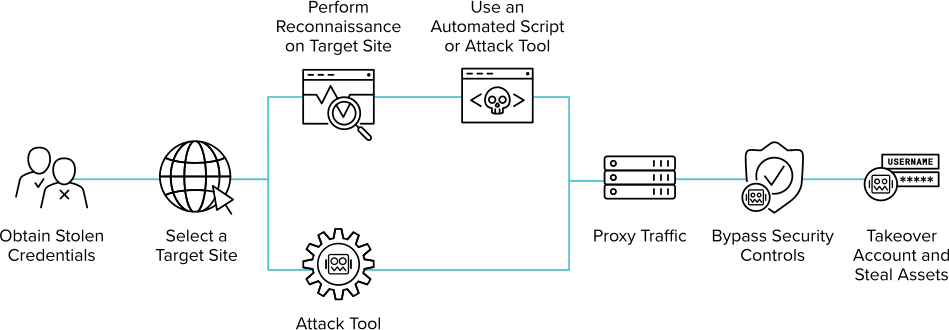
The web application security market has evolved to keep pace with the new digital economy. While the web application firewall (WAF) has proven to be an effective tool for mitigating application vulnerabilities, a proliferation of APIs, third-party ecosystems, and advancements in attacker sophistication has sparked a convergence of WAF, API security, bot management, and DDoS mitigation into WAAP solutions to protect apps and API endpoints from a variety of risks including zero-day exploits, business logic attacks, and automated threats that can lead to account takeover (ATO).
A highly competitive digital landscape has led organizations to embrace modern software development to get ahead in the market, resulting in rapid release cycles to introduce new features and a mashup of integrations, front-end user interfaces, and back-end APIs. While it is not a weakness or defect to have a shopping cart or loyalty program, the endpoints that facilitate commerce and customer engagement are a prime target for attackers, requiring that all user interaction and business logic be protected from software vulnerabilities as well as inherent vulnerabilities that can result in abuse of logon, create account, and add to cart functions via bots and malicious automation.
APIs, like traditional web apps, are subject to numerous risks including weak authentication/authorization controls, misconfiguration, and server-side request forgery (SSRF). Even businesses with good API security practices may still be exposed. Third-party integrations and AI ecosystems that span hybrid and multicloud environments dramatically increases the threat surface for defenders. Rogue API endpoints, often referred to as shadow and zombie APIs, create a need for continuous discovery and automated protection; ideally in code, during testing, and in runtime.
Today, customers have unprecedented choice and low tolerance for bad experiences. Any security incident or friction when transacting, including performance delays and excessive authentication challenges, may result in revenue loss and even brand abandonment.
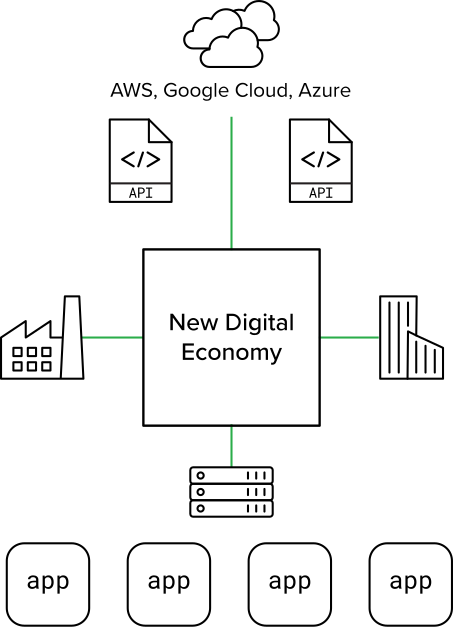
The new digital economy thus requires a new era in application security to safely unleash innovation, effectively manage risk, and reduce operational complexity.
“The status quo simply won’t cut it—with over 40,000 disclosed vulnerabilities (CVEs) in 2024, and AI-enhanced attacks on the rise—applications and APIs are under assault.”
Why the pressing need for WAAP?
Widespread adoption of cloud followed by a rise of Generative AI has led to an array of architectures and interdependencies between application components. Traditional three-tier web stacks are being retrofitted or even replaced with modern apps that leverage decentralized architectures based on microservices to facilitate API-to-API communication. Management of multiple security stacks and cloud-native toolkits across environments has led to untenable complexity and created significant challenges for incident responders, as it is impractical to manually remediate threats that are being quickly weaponized with AI. Yet, easily accessible mobile apps and third-party integrations via APIs speed time to market and are key to maintaining competitive advantage in a market defined by constant digital innovation.
Architectural decentralization, agile software development, and complex software supply chains have increased the threat surface and introduced unknown risks, necessitating renewed focus on Shift Left principles such as threat modeling, code scanning, and penetration testing, and concerted efforts to maintain a consistent security posture across environments. In addition to mitigating exploits and misconfiguration, InfoSec must strive to protect apps and APIs across the entire Software Development Lifecycle (SDLC) and defend critical business logic from abuse.
API proliferation and tool sprawl is so pervasive that we are reaching an inflection point. Security teams will need to embrace telemetry to glean actionable insights and employ artificial intelligence to automatically tune security countermeasures to adequately mitigate risk.
The north star is to make application security intrinsic by employing continuous defenses that consistently offset risk—from code through testing into runtime—across data centers, clouds, and the edge.

Customer and revenue growth
Organizations that consistently deliver secure digital experiences will achieve customer and revenue growth.

Competitive advantage
Cybersecurity incidents and customer friction are the biggest risks to digital success and competitive advantage.

Expanded threat surface
Architectural sprawl and interdependencies have dramatically expanded the threat surface for sophisticated attackers.
What makes for good WAAP?
Due to the complexity of securing web apps and APIs from a constant onslaught of exploits and abuse, cloud-delivered as-a-Service WAAP platforms are growing in popularity. These platforms have emerged from a variety of vendors, including CDN incumbents, application delivery pioneers, and pure-play security vendors that have expanded into adjacent markets through acquisition.
“After 20 years of web app security best practices, new risks dramatically change the calculus.”
Effectiveness and ease-of-use are often cited as key buying criteria for WAAP but are subjective and difficult to verify during vendor selection.
A more practical approach is to define and group WAAP value propositions into table stakes, short list capabilities, and differentiators to help organizations make the most informed choice.
Table Stakes
Short List Capabilities
Differentiators
Easy onboarding and low maintenance monitoring
Positive security model with automated learning
Universal visibility and consistent enforcement for apps and APIs everywhere
Comprehensive security analytics
Behavioral analysis and anomaly detection
Maximum detection rate (efficacy)
Sophistication beyond signatures, rules, threat intelligence
False positive remediation
Automated Ops
API discovery and schema enforcement
Integration with security ecosystems and DevOps tools
Full lifecycle API security
Scalable protection against bots and automated attacks
Evasion countermeasures
Transparent protection that reduces user friction
Table Stakes
Easy onboarding and low maintenance monitoring
Comprehensive security analytics
Sophistication beyond signatures, rules, threat intelligence
API discovery and schema enforcement
Scalable protection against bots and automated attacks
Short List Capabilities
Positive security model with automated learning
Behavioral analysis and anomaly detection
False positive remediation
Integration with security ecosystems and DevOps tools
Evasion countermeasures
Differentiators
Universal visibility and consistent enforcement for apps and APIs everywhere
Maximum detection rate (efficacy)
Automated Ops
Full lifecycle API security
Transparent protection that reduces user friction
What makes the best WAAP?
Best-in-class WAAP helps organizations improve their security posture at the speed of business, mitigate compromise without friction or excessive false positives, and reduce operational complexity to deliver secure digital experiences at scale—wherever apps and APIs need to be.
Continuous protection and consistent security
- Universal observability across hybrid and multicloud environments
- Consistent policy enforcement and remediation
- Early detection of risks in code and during testing
Improve security posture at the speed of business
- CI/CD pipeline integration
- Dynamic API discovery and schema enforcement
- Automated protection and adaptive security
Mitigate compromise with minimal friction and false positives
- Real-time mitigation and retrospective analysis
- Accurate detection without strict security challenges
- Resilience during attacker retooling, escalation, evasion
Reduce operational complexity
- Mitigate risk of “shadow IT” and insecure third-party integrations
- Streamline security across data center, clouds, and the edge
- Remove architectural constraints to deploy security on-demand where needed
“API sprawl is shockingly pervasive: Today, the average number of APIs organizations use is over 20,000.”
The best WAAP delivers effective and easy-to-operate security on a distributed platform.
Effective Security
Distributed Platform
Easy to Operate
Continuous detection and mitigation
Universal visibility across clouds and architectures
Self-service deployment
Retrospective analysis
Intrinsic security for all apps and APIs
Self-tuning security
Low friction
Consistent security posture and incident response
Comprehensive dashboards and contextual insights
Low false positives
Seamless remediation of emerging threats
AI-assisted operations
Effective Security
Continuous detection and mitigation
Retrospective analysis
Low friction
Low false positives
Distributed Platform
Universal visibility across clouds and architectures
Intrinsic security for all apps and APIs
Consistent security posture and incident response
Seamless remediation of emerging threats
Easy to Operate
Self-service deployment
Self-tuning security
Comprehensive dashboards and contextual insights
AI-assisted operations
The F5 WAAP advantage
F5 WAAP adapts as apps and attackers evolve to secure customer experiences in the new digital economy.

Real-time mitigation
Robust security, threat intelligence, and anomaly detection protects all apps and APIs from exploits, bots, and abuse to prevent compromise, ATO, and fraud in real-time.

Retrospective analysis
Correlated insights across multiple vectors and ML-based evaluation of security events, login failures, policy triggers, and behavioral analysis enables continuous self-learning.

Automated protection
Dynamic discovery and policy baselining enable auto mitigation, tuning, and false positive remediation throughout the development/deployment lifecycle and beyond.

Adaptive security
Autonomous security countermeasures that react as attackers retool deceives and convicts bad actors without relying on mitigations that disrupt the customer experience.

Distributed platform
Unified application fabric deploys security on-demand where needed for consistent protection from app to edge.

Ecosystem integration
API-driven deployment and maintenance that easily integrates into broader development frameworks, CI/CD pipelines, and event management systems.
Credential stuffing attack example
Condition
Identification
Abuse
Anomaly detection
Intent
Behavioral analysis
Origination
Stage 1 ML
Evasion
Stage 2 ML
Condition
Abuse
Intent
Origination
Evasion
Identification
Anomaly detection
Behavioral analysis
Stage 1 ML
Stage 2 ML
Accurate detection and auto mitigation
Credential stuffing playbook